
Views: 0
An ERW tube mill is a continuous steel pipe manufacturing system that produces welded pipes from steel strips through forming, high-frequency welding, sizing, and cutting processes.
ERW stands for Electric Resistance Welding, which refers to the method used to join the edges of formed steel strips.
Unlike traditional pipe manufacturing methods, an ERW tube mill allows continuous production with:
High manufacturing efficiency
Stable pipe dimensions
Lower material waste
Flexible production capability
The complete working process involves multiple sections working together:
Coil preparation
Strip forming
Welding
Cooling
Sizing
Cutting
Quality inspection
Shijiazhuang Faith Machinery Co., Ltd provides ERW tube mill solutions for customers requiring steel pipe production equipment, including customized production lines according to pipe specifications and capacity requirements.
Website:
https://www.faith-machinery.com/
Email:
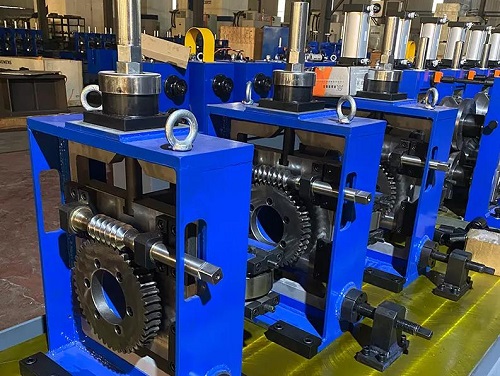
The ERW tube mill production process begins with steel coils.
The uncoiler system holds the steel coil and releases the steel strip continuously into the production line.
The main functions include:
Supporting the coil weight
Maintaining stable strip feeding
Controlling material tension
A stable feeding process is important because uneven strip movement can affect the final pipe quality.
Before forming, the steel strip passes through preparation equipment.
This process helps:
Remove strip deformation
Improve forming stability
Maintain consistent production
Proper strip preparation reduces problems during welding and sizing.
The forming section is responsible for changing the flat steel strip into a round pipe shape.
The process is completed through multiple roller stations.
Each roller gradually adjusts the strip shape:
Flat strip entering the forming section
Edge bending
Circular tube formation
Preparation for welding
The forming process requires precise roller design to maintain:
Pipe diameter accuracy
Proper edge alignment
Stable welding conditions
Forming rollers are customized according to:
Pipe diameter
Wall thickness
Steel material
The quality of roller design directly affects:
Pipe appearance
Production stability
Energy consumption
After forming, the steel strip becomes an open tube shape with two edges meeting together.
The high-frequency welding system heats the edges through electrical resistance.
The process includes:
Generating high-frequency current
Heating steel edges
Applying pressure
Creating a welded joint
No additional welding material is usually required in this process.
Welding quality directly affects pipe performance.
Important control factors include:
Welding temperature
Welding speed
Pressure adjustment
Edge alignment
A stable welding system helps produce pipes with:
Consistent seam quality
Reliable mechanical properties
Smooth production operation
After welding, excess material from the weld area may need to be removed.
This improves:
Surface smoothness
Pipe appearance
Processing quality
The welded area requires controlled cooling.
Proper cooling helps maintain:
Pipe structure stability
Dimensional accuracy
Production consistency
After welding and cooling, the pipe enters the sizing section.
Sizing rollers control:
Outer diameter
Roundness
Straightness
This stage ensures the finished pipe meets customer specifications.
Straightening equipment improves the final pipe shape.
It helps achieve:
Better appearance
Accurate dimensions
Easier downstream processing
Modern ERW tube mills often use flying saw systems.
The cutting unit moves together with the pipe during operation.
Advantages include:
Continuous production
Accurate cutting length
Reduced production interruption
After cutting, pipes are collected and prepared for:
Inspection
Packaging
Storage
Transportation
The uncoiler provides continuous steel strip feeding.
Key requirements include:
Stable operation
Accurate tension control
Efficient coil changing
The forming mill gradually shapes steel strips into pipes.
It includes:
Roller stations
Guide systems
Adjustment mechanisms
The welding system is the core part of ERW pipe production.
It determines:
Welding quality
Production speed
Pipe reliability
The sizing section ensures finished pipe accuracy.
It controls:
Diameter tolerance
Pipe shape
Surface quality
The cutting system prepares pipes for final delivery.
It includes:
Cutting equipment
Pipe collecting systems
Production monitoring
The quality of raw steel strips affects:
Welding stability
Pipe strength
Surface finish
Suitable raw materials help improve production efficiency.
ERW tube mill speed depends on:
Pipe size
Wall thickness
Welding capability
Machine configuration
Higher speed requires more precise equipment control.
Roller design affects:
Forming quality
Energy consumption
Pipe consistency
Professional roller design is essential for stable production.
Modern ERW tube mills often integrate:
PLC control
Digital monitoring
Automatic adjustment
Automation improves:
Production efficiency
Operating convenience
Product consistency
ERW tube mills are designed for continuous operation.
Benefits include:
Higher output
Efficient production workflow
Reduced downtime
ERW pipes produced by tube mills are used in:
Construction
Structural projects
Mechanical manufacturing
Transportation systems
Industrial applications
Compared with some traditional production methods, ERW manufacturing provides:
Lower material waste
Efficient steel strip usage
Competitive production cost
A professional ERW tube mill supplier should understand:
Pipe production requirements
Equipment configuration
Manufacturing technology
Different customers may require different specifications.
Customization may involve:
Pipe diameter range
Wall thickness
Production speed
Factory layout
A complete supplier service should include:
Installation guidance
Operator training
Spare parts support
Technical assistance
Shijiazhuang Faith Machinery Co., Ltd provides ERW tube mill solutions designed according to customer production requirements.
Solutions include:
ERW pipe mills
Steel tube production lines
Pipe making machines
Related steel processing equipment
Faith Machinery supports customers involved in:
Steel pipe manufacturing
Tube production expansion
Industrial pipe projects
The company provides technical communication before equipment selection to help customers choose suitable configurations.
Website:
https://www.faith-machinery.com/
Email:
ERW means Electric Resistance Welding. It is a welding method that joins steel strip edges through electrical resistance heating.
ERW tube mills commonly process:
Carbon steel
Galvanized steel
Mild steel strips
The exact material range depends on equipment configuration.
ERW tube mills can produce:
Round steel pipes
Square tubes
Rectangular tubes
Structural pipes
ERW tube mills are popular because they provide:
Continuous production
Efficient manufacturing
Flexible pipe production capability
How Does an ERW Tube Mill Work, ERW Tube Mill Process, ERW Pipe Manufacturing Process, ERW Tube Mill Manufacturer, High Frequency Welding Tube Mill, ERW Pipe Production Line, Steel Tube Mill Machine, Pipe Making Machine, Tube Mill Manufacturer China, Welded Pipe Production Equipment
 English


