
Views: 0
The global demand for welded steel pipes continues to grow as infrastructure development, construction projects, and industrial manufacturing expand worldwide. Steel pipes are widely used in structural engineering, water transportation systems, oil and gas pipelines, automotive manufacturing, and mechanical equipment production.
To meet these demands, manufacturers rely on advanced equipment such as steel tube mill machines, ERW tube mill production lines, steel pipe making machines, and coil processing systems. These machines allow factories to convert steel coils into finished welded pipes efficiently through automated forming and welding processes.
For investors planning to establish or upgrade a pipe manufacturing plant, understanding the price of steel tube mill machines is essential. Equipment cost depends on factors such as pipe diameter range, production speed, automation level, and the overall configuration of the production line.
This comprehensive guide explains the 2026 price range of steel tube mill machines, the components included in a complete tube mill production line, and the key factors that influence equipment cost.
A steel tube mill machine is an industrial system designed to produce welded steel pipes from steel strip or coil materials. The machine gradually forms the steel strip into a circular tube and then welds the edges together using high-frequency electric resistance welding technology.
Modern tube mill production lines typically include several integrated machines that operate continuously to ensure efficient manufacturing.
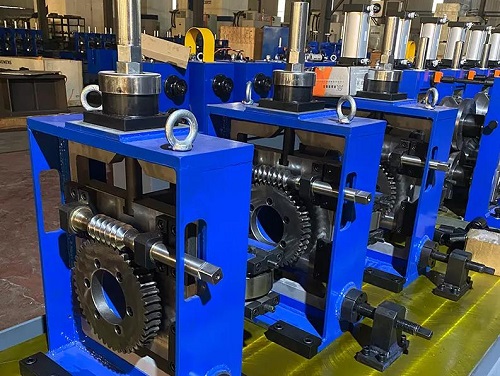
The main processes involved include:
| Production Stage | Function |
|---|---|
| Coil feeding | Steel coil is loaded and fed into the production line |
| Strip forming | Rollers gradually shape steel strip into a tube |
| High-frequency welding | Tube edges are welded together |
| Weld bead removal | Excess welding material is removed |
| Pipe sizing | Pipe diameter and shape are calibrated |
| Flying cutting | Pipes are cut to required lengths |
This continuous production method allows factories to produce large volumes of steel pipes with stable quality.
The cost of a tube mill machine varies depending on the pipe size range, production capacity, and equipment configuration.
Below is a typical price overview for steel tube mill machines in 2026.
| Tube Mill Type | Pipe Diameter Range | Price Range |
|---|---|---|
| Small tube mill machine | 10 – 50 mm | $30,000 – $120,000 |
| Medium ERW tube mill line | 50 – 165 mm | $120,000 – $400,000 |
| Large structural tube mill | 165 – 325 mm | $400,000 – $1,200,000 |
| Heavy industrial pipe mill | 325 mm and above | $1,200,000 – $3,000,000 |
Smaller machines designed for light structural tubing are relatively affordable, while large industrial pipe mills require significant investment due to their size and power requirements.
In many cases, factories purchase a complete steel pipe production line rather than a single machine. A full production line includes additional equipment required for continuous manufacturing.
The estimated cost of a complete welded pipe production line is shown below.
| Production Line Capacity | Estimated Investment |
|---|---|
| Small pipe factory | $200,000 – $500,000 |
| Medium pipe manufacturing plant | $500,000 – $1,500,000 |
| Large industrial pipe plant | $1,500,000 – $5,000,000 |
The total investment includes not only machinery but also factory infrastructure, electrical systems, and installation services.
A modern pipe manufacturing plant typically includes multiple machines working together.
| Equipment | Function |
|---|---|
| Hydraulic decoiler | Holds and feeds steel coils |
| Strip accumulator | Maintains continuous material flow |
| Roll forming mill | Shapes steel strip into tubes |
| High-frequency welding unit | Welds pipe seams |
| Pipe sizing machine | Adjusts pipe diameter |
| Flying saw cutting system | Cuts pipes to required length |
| Run-out table | Collects finished pipes |
Each machine plays an essential role in maintaining continuous pipe production.
The specifications of tube mill machines vary depending on the model and pipe size requirements.
Below is a typical technical configuration for a medium-size ERW tube mill.
| Parameter | Specification |
|---|---|
| Pipe diameter range | 20 – 219 mm |
| Wall thickness | 1.2 – 8 mm |
| Production speed | 30 – 120 m/min |
| Raw material | Carbon steel coil |
| Welding method | High-frequency ERW |
| Control system | PLC automation |
| Cutting system | Flying cold saw |
Advanced machines may include additional automation systems to improve production efficiency.
Several important factors influence the cost of tube mill equipment.
Machines designed for larger pipes require stronger frames, larger motors, and more robust forming stands, which increases equipment cost.
High-speed production lines require advanced control systems and stronger components, resulting in higher prices.
Automation features such as servo drives, PLC control systems, and automatic roll adjustment increase equipment efficiency but also raise the machine cost.
A complete production line with slitting lines, accumulators, and automated cutting systems will cost significantly more than a basic tube mill machine.
High-quality steel structures, bearings, and electrical components ensure longer machine lifespan but also increase manufacturing cost.
Besides the initial machine price, manufacturers must consider operational costs.
Steel coil is the primary raw material and usually accounts for the largest portion of production expenses.
High-frequency welding units and large motors consume significant electrical power during operation.
A typical tube mill production line requires several operators per shift to monitor equipment and ensure smooth production.
Regular replacement of forming rollers, bearings, and welding components helps maintain stable machine performance.
Modern steel pipe making machines provide several advantages for manufacturers.
Continuous production allows factories to produce large volumes of pipes quickly.
High-frequency welding technology ensures strong weld seams with consistent quality.
Manufacturers can produce different pipe sizes by changing forming rollers.
Advanced PLC systems allow precise control of production parameters.
Steel pipes produced by tube mill machines are used in many industrial sectors.
Construction Industry
Steel pipes are widely used in structural frames, scaffolding systems, and building foundations.
Oil and Gas Transportation
Pipelines require durable welded pipes for transporting oil, gas, and other fluids.
Automotive Manufacturing
Vehicles use steel tubes in chassis components and exhaust systems.
Mechanical Engineering
Industrial machinery often requires precision steel tubing.
When purchasing steel pipe manufacturing equipment, several factors should be evaluated.
The selected machine must match the required daily pipe production volume.
Choose equipment capable of producing the pipe diameters required by your market.
Experienced equipment manufacturers can provide reliable machine design and technical support.
Professional installation guidance and technical training are important for ensuring smooth operation.
Small tube mills may cost between $30,000 and $120,000, while large industrial production lines may exceed $1 million depending on specifications.
Major factors include pipe diameter range, production speed, automation level, and the overall configuration of the production line.
Yes. By replacing forming rollers and adjusting machine parameters, manufacturers can produce pipes with different diameters.
Installation and commissioning usually take 30 to 90 days, depending on the complexity of the production system.
Most welded pipes are produced using carbon steel coils or galvanized steel strips.
Steel tube mill machines are essential equipment for modern welded pipe manufacturing plants. Understanding the price range, equipment configuration, and technical specifications helps investors make informed decisions when planning a steel pipe production facility.
The cost of tube mill equipment depends on production capacity, pipe size range, and automation level. While small tube mills require relatively modest investment, large industrial pipe production lines may involve significant capital expenditure.
With proper equipment selection and efficient production management, manufacturers can produce high-quality steel pipes for construction, infrastructure, and industrial applications.
Shijiazhuang Faith Machinery Co., Ltd
Professional manufacturer of steel pipe making machines and tube mill production lines.
Tel: +86 15350593960
Email: crystal@faith-machinery.com
 English


