
Views: 0
Eddy current testing (ECT) is one of the most widely used non-destructive testing (NDT) methods in the steel tube, pipe, automotive, aerospace, and industrial manufacturing sectors. By using electromagnetic induction principles, an eddy current testing machine can detect surface defects, near-surface cracks, weld discontinuities, material inconsistencies, and dimensional variations without damaging the product.
As quality standards continue to increase across global industries, manufacturers require reliable and high-speed inspection systems capable of integrating directly into production lines. Professional eddy current testing machine manufacturers in China provide advanced solutions that help improve product quality, reduce defects, and ensure compliance with international standards.
Shijiazhuang Faith Machinery Co., Ltd. specializes in steel tube mill equipment, NDT inspection systems, eddy current testing machines, hydrostatic testing equipment, and complete pipe production line solutions for customers worldwide.
Email: crystal@faith-machinery.com
An eddy current testing machine is a non-contact inspection system that uses alternating electromagnetic fields to detect flaws in conductive materials.
When an alternating current passes through a testing coil:
A magnetic field is generated.
Eddy currents are induced in the test material.
Material defects disturb the eddy current flow.
The system analyzes signal changes.
Defects are identified and recorded.
This method allows rapid and continuous inspection during manufacturing processes.
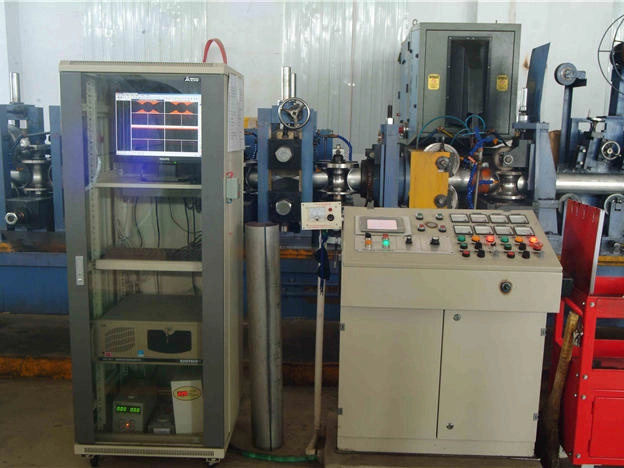
Modern manufacturers rely on eddy current testing to achieve:
Improved product quality
Early defect detection
Reduced scrap rates
Continuous production monitoring
Compliance with customer specifications
Non-destructive inspection
ECT is particularly valuable because it provides real-time inspection without interrupting production.
Eddy current inspection is commonly used for:
ERW steel pipes
Welded tubes
Seamless tubes
Stainless steel tubing
The system can detect:
Weld defects
Surface cracks
Pinholes
Material discontinuities
Modern tube mills integrate eddy current testing systems directly into production.
Benefits include:
Online inspection
Immediate defect detection
Improved production efficiency
Used for inspection of:
Drive shafts
Tubular components
Precision-machined parts
ECT helps identify small surface defects in critical components where safety and reliability are essential.
Tube integrity testing helps prevent leakage and operational failures.
A probe or testing coil produces an alternating magnetic field.
The conductive material generates circulating electrical currents beneath the surface.
Cracks, voids, corrosion, or weld imperfections alter the flow of eddy currents.
The inspection system analyzes signal variations.
The machine displays, records, and classifies detected anomalies.
| Defect Type | Detection Capability |
|---|---|
| Surface Cracks | Excellent |
| Weld Defects | Excellent |
| Pinholes | Good |
| Corrosion | Good |
| Material Variation | Good |
| Near-Surface Defects | Excellent |
| Factor | Eddy Current Testing | Ultrasonic Testing |
|---|---|---|
| Contact Required | No | Usually Yes |
| Inspection Speed | High | Medium |
| Surface Crack Detection | Excellent | Good |
| Internal Defect Detection | Limited | Excellent |
| Automation Integration | Easy | Moderate |
| Production Line Use | Common | Common |
Eddy current testing is often preferred for high-speed online inspection of welded and seamless tubes, while ultrasonic testing is frequently used for deeper internal defect detection.
Suitable for:
Small-diameter tubes
Precision tubing
High-accuracy inspection
Advantages:
Comprehensive coverage
High sensitivity
Commonly used in pipe manufacturing.
Benefits:
High-speed inspection
Continuous production integration
Stable performance
Provides:
Enhanced defect analysis
Higher inspection accuracy
Advanced data processing
ERW pipe manufacturers commonly use eddy current testing to inspect weld seams.
Inspection objectives include:
Detecting weld cracks
Identifying lack of fusion
Verifying weld quality
Reducing defective product shipments
ECT systems are often installed immediately after welding and sizing processes.
Generates electromagnetic fields and receives inspection signals.
Converts electrical responses into defect information.
Modern systems often feature:
PLC controls
Touchscreen interfaces
Real-time monitoring
Can automatically identify and mark defective products.
Supports quality documentation and production traceability.
Products remain fully usable after testing.
Suitable for continuous production environments.
Allows immediate process adjustments.
Early detection minimizes defective output.
Compatible with modern pipe production lines.
| Industry | Typical Application |
|---|---|
| Steel Pipe Manufacturing | Weld inspection |
| Automotive | Component testing |
| Aerospace | Surface crack detection |
| Power Generation | Tube inspection |
| Oil & Gas | Pipeline quality control |
| Heat Exchanger Manufacturing | Tube integrity verification |
Inspection requirements vary based on:
Diameter range
Wall thickness
Material type
Production speed
Different applications require different inspection precision levels.
Automated systems improve consistency and reduce labor requirements.
Modern quality systems increasingly require inspection records and traceability.
Reliable service support helps maintain production continuity.
Different industries may require different testing sensitivity levels.
Long-term reliability and inspection accuracy often provide greater value.
The testing machine should integrate smoothly with existing equipment.
Scalable systems can support future production growth.
Shijiazhuang Faith Machinery Co., Ltd. provides advanced steel tube production equipment and non-destructive testing solutions for global manufacturers.
Experience in tube mill manufacturing
Eddy current testing system integration
Customized inspection solutions
PLC-based automation systems
Technical training and support
International project experience
We support steel pipe manufacturers, tube mills, industrial equipment producers, and quality control facilities worldwide.
It is used to detect surface and near-surface defects in conductive materials without damaging the product.
Yes. It is widely used for weld inspection in ERW pipe manufacturing.
Yes. It is one of the most efficient inspection methods for continuous manufacturing environments.
Conductive materials such as carbon steel, stainless steel, copper, aluminum, and alloy metals.
No. Eddy current testing and hydrostatic testing serve different quality control purposes and are often used together.
Yes. Systems can be configured according to pipe dimensions, production speeds, and quality requirements.
Reliable inspection systems are essential for modern manufacturing operations. A high-quality eddy current testing machine helps improve product consistency, reduce defects, and meet international quality standards.
Shijiazhuang Faith Machinery Co., Ltd. supplies eddy current testing machines, hydrostatic testing equipment, ERW tube mill solutions, and complete steel pipe production line systems for customers worldwide.
Email: crystal@faith-machinery.com
eddy current testing machine manufacturer, eddy current testing equipment supplier, eddy current testing machine factory China, ECT inspection system, steel pipe eddy current tester, ERW tube mill inspection equipment, non-destructive testing machine manufacturer, weld inspection system supplier, tube testing machine China, Shijiazhuang Faith Machinery Co., Ltd.
 English


